Facing Fear of Change: Train Your Mind to Move Forward Without Self-Sabotage
- Oct 28, 2025
- 4 min read
Fear of change is one of the most common and deeply rooted fears we experience as human beings. But it rarely shows up on its own. Instead, it tends to hide within other more fundamental fears, as shown in classic psychological studies about “core fears.”
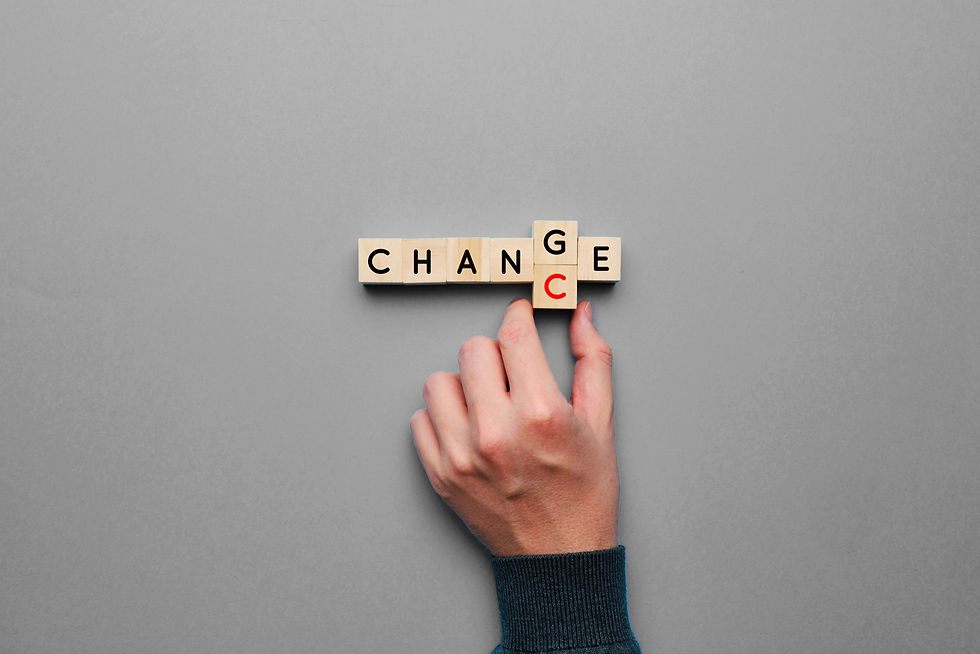
Fear of failure or fear of the unknown are two clear examples where fear of change plays a major role. Think about wanting to change jobs after years in the same role. You already have the experience, the network, and the knowledge—but still feel empty. Sunday night rolls around, and you feel that anxiety, that knot in your stomach at the thought of going back to a job that no longer inspires you. Instead of energizing you, it drains you.
Still, we can go years surviving week after week, month after month, without taking action. Why? Because we’re afraid. Afraid of failing, of the unknown, of losing control.
We begin to harshly question ourselves:
“How am I going to find a job if I’ve been doing the same thing for years?”
“I don’t have enough experience.”
“What if I’m not chosen… or worse, what if I am and I can’t handle it?”
And then comes the infamous phrase: “Better the devil you know than the devil you don’t.”Sadly, this has become a collective excuse to justify self-sabotage.
We’re so conditioned to avoid risk that we choose the discomfort of the familiar over the uncertainty of change. What if it gets worse on the other side? It’s hard to see change as an opportunity.
Why do we fear change?
The 3 main roots:
1. Biological
Our brain is wired for survival, not evolution. When faced with the unknown, the amygdala the emotional part of the brain — gets activated and scans for threats. This triggers an automatic response: fight, flight, or freeze.
The brain doesn’t distinguish between a real threat — like being chased by a bear — and a non-threatening change, like moving to a new place, changing jobs, speaking in public, or starting a new relationship.
To the brain, change = danger.
In short: the brain doesn’t see change as an opportunity, but as a potential threat.
2. Mental:
Here’s where limiting beliefs come in—stories shaped by past experiences. The human mind naturally leans toward the negative:
“What if it doesn’t work?”
“It’s too late for me.”
“I’m not enough.”
And we unconsciously try to prove ourselves right:
“I knew it wouldn’t work.”
“I knew I couldn’t do it.”
These beliefs aren’t based in the present, but we treat them like absolute truths.Sometimes, we even sabotage ourselves just to confirm those intrusive thoughts.
Fear of change is not fear of the future. It's fear of feeling the pain or discomfort of the past again. (Read that again.)
3. Emotional
It triggers deep fears like:
Rejection (for choosing a different path)
Loss of stability, relationships, status, or control
Feeling shame, disappointment, or insecurity
Since ancient times, humans have needed belonging to survive. So change can feel like a threat to that emotional connection.
Sometimes, we believe that if we change, we’re betraying someone: our family, friends, partner—or even our past self.
How do you know if fear of change is showing up in your life?
Subtle but common signs:
“Smart” procrastination: delaying important tasks with “productive” distractions
Perfectionism: waiting for the perfect time (which never comes)
Over-preparation: endless courses or research without real action
Default phrases: like “Better the devil you know than the devil you don't”
Does any of this sound familiar? Don’t worry—it’s more common than you think. You’re not alone.
The good news is your brain can be trained
We can reprogram our minds to interpret fear as a signal for growth, not a threat.
You don’t need to be fully ready. What you need is to be willing.
Change isn’t about becoming someone else. Sometimes, it’s about returning to your most authentic self. It’s about quieting that inner voice that resists change — or, in other words, resists growth. That voice is NOT you. It’s just isolated fear, shaped by past experiences we’ve mistaken for our identity.
And if you ever doubt it, think about this: Are babies born afraid? No.Their brains start learning from the environment, collecting "data" to survive.But they’re not born with limiting beliefs — they learn them.
5 Brain Exercises to Embrace Change
1. Question and challenge the limiting thought
When a thought like “I can’t” or “I’m not enough” shows up, pause and ask yourself:
Where is this thought coming from?
Has something similar happened before?
Is this truly a threat today?
2. Shift your inner dialogue
Replace limiting questions with empowering ones:
“What if everything goes wrong?” → “What if everything goes right?”
“What if I’m not enough?” → “What if it’s just a matter of time while I learn and grow?”
3. Mental training (not the same as visualization — I’ll write more about this in another post)
Take 7 deep breaths. Then, with your eyes closed, picture the change as if it already happened — and it went well. Feel it in your body. Live it.This isn’t just visualizing — this is training your brain to experience the success as if it were real.
4. Daily micro-challenge
For 7 days, take one small uncomfortable action each day:
Share an idea with a group of people or during a meeting, especially if it’s not something you usually do
Change up your daily routine
Start something you’ve been putting off for a while
5. Powerful self-inquiry
What part of me is afraid? What’s the worst that could happen?
What part of me does wants this change?
What can I learn from this situation? What opportunity might be here?
What’s the best that could happen if I take action?
To wrap up, I’ll leave you with 3 thoughts to reflect on:
Fear doesn’t go away but it can learn to walk beside you.
Change doesn’t require perfection, just a repeated decision.
Start scared, but start! Take action.
And you? What change have you been putting off?
Let me know in the comments if you tried any of the exercises and how it went!
— Isnar
Comments